




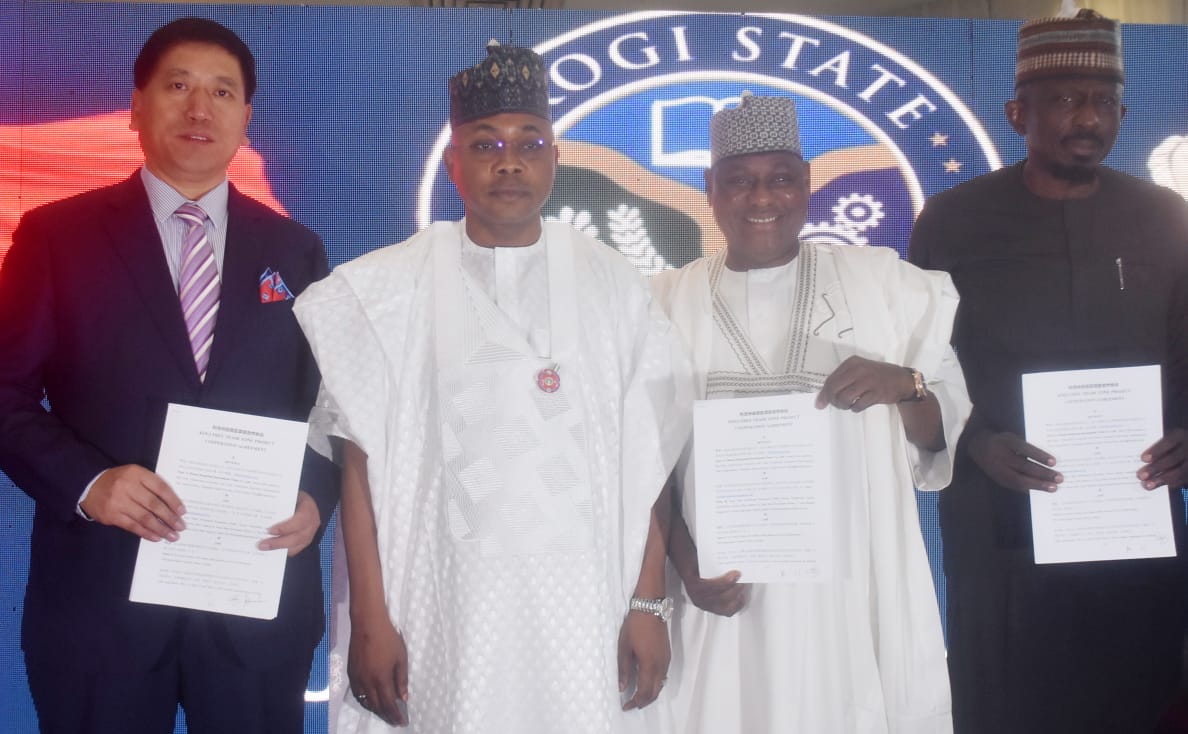
Kogi State officially launched the Ajaokuta Economic City on Tuesday, a landmark free trade zone expected to attract between $2 billion and $5 billion in foreign direct investment (FDI) over the next seven years. The unveiling, held in Abuja, marks one of the most ambitious economic development initiatives in Kogi’s history, signalling a significant step toward positioning the state as a leading industrial hub in Nigeria.
Speaking during the ceremony, Governor Ahmed Usman Ododo described the occasion as a defining moment in Kogi’s economic transformation journey. He stated that the new economic city would reshape the state’s role in national development and enhance its participation in global commerce.
The event, attended by senior government officials, private-sector investors, and a delegation from China’s Hunan Province, confirmed the commencement of operations for the free trade zone that had been earlier approved by the Federal Government. Stakeholders have also referred to the project as the Kogi–Hunan Free Trade Zone, highlighting its strong international partnership.
“Today, we present the Ajaokuta Economic City—a project whose scale and potential rank among the most transformative economic initiatives in our nation’s history,” Governor Ododo said. He explained that the free trade zone emerged from extensive technical studies, strategic consultations, and engagement with both domestic and international partners.
Governor Ododo revealed that his administration had developed a comprehensive security architecture to safeguard investments within the Economic City. He emphasised that sustained security remains “an uncompromising priority,” noting improvements in intelligence gathering, enhanced surveillance, and stronger cooperation with federal security agencies.
“The Ajaokuta Economic City will operate under a dedicated security system designed to protect life, infrastructure, and capital. Investment thrives only where there is safety, and we are committed to ensuring that every investor feels secure,” he stated.
The governor used the unveiling ceremony to respond to critics who claim his administration has not delivered on its promises. Ododo emphasised that his leadership style prioritises results over publicity, and the Economic City serves as proof of the state’s determined pursuit of development.
“Our work speaks for itself. This is what we are doing in Kogi State. Some may say the governor is not talking or working, but I prefer to let actions speak louder than words,” he said.
He invited journalists and stakeholders to visit Kogi State, beginning January 3, for a three-week inspection tour of ongoing projects, assuring the public that his administration is focused on achieving measurable results.
Governor Ododo expressed gratitude to development partners, investors, and citizens for their support of the initiative. He described the Ajaokuta Economic City as “a seed of generational prosperity” that will unlock new revenue streams, drive industrial growth, and strengthen Kogi’s integration into global supply chains.
In his remarks, Chief Economic Adviser to the Governor and CEO of the Kogi State Investment Promotion and Public-Private Partnership Agency (KSIPPA), Salami Ozomata Inda, stated that the free trade zone is situated on 4,000 hectares of strategically allocated land.
According to him, the project has already secured Presidential approval, and Tuesday’s unveiling marks a significant milestone in the state’s industrialisation roadmap. He credited President Bola Ahmed Tinubu for his support and commended the governor for steering the vision “from the front.”
Inda said the Economic City will significantly expand Kogi’s revenue base, deepen industrial capacity, and attract world-class investors looking for long-term opportunities in production, logistics, innovation, and export-driven ventures.
The Chinese delegation, led by Mr Li Zhensheng of the Zhuzhou Municipality in Hunan Province, reaffirmed China’s commitment to supporting the Economic City. Zhensheng said the project represents a flagship collaboration under the Kogi–Hunan Sister Province Agreement.
He described the Economic City as “a long-term strategic investment” with enormous potential in technology transfer, industrial development, and expanded trade relations between Nigeria and China.
Delivering the technical presentation, Dr Sanni Ozomata, the Governor’s Technical Adviser, highlighted the project’s multi-sectoral benefits. He said the Economic City is projected to attract up to $5 billion in FDI, generate at least 50,000 direct and indirect jobs, and create $500 million in annual export value within five years.
According to him, Phase One alone aims to create between 10,000 and 15,000 jobs, backed by plans to establish a 100-megawatt power plant, develop a railway connection to Nigeria’s national rail network, and expand opportunities across mining, agro-processing, manufacturing, logistics, and technology innovation.
Ozomata emphasised Kogi’s geographic advantage, noting that the state is bordered by 10 states and the FCT, making it Nigeria’s most central logistics hub. He added that Kogi’s rich mineral and agricultural resources position the Economic City for massive industrial success.
Kogi’s Commissioner for Finance, Budget, and Economic Planning, Asiwaju Asiru Idris, urged investors to take advantage of the new free trade zone, describing it as one of the most promising industrial opportunities in Nigeria today.
“Kogi State has already created the policy and legislative frameworks investors need. Returns will be strong, secure, and sustainable. If Dangote and Mangal Group are thriving in Kogi, why are you not here yet?” he asked.
