




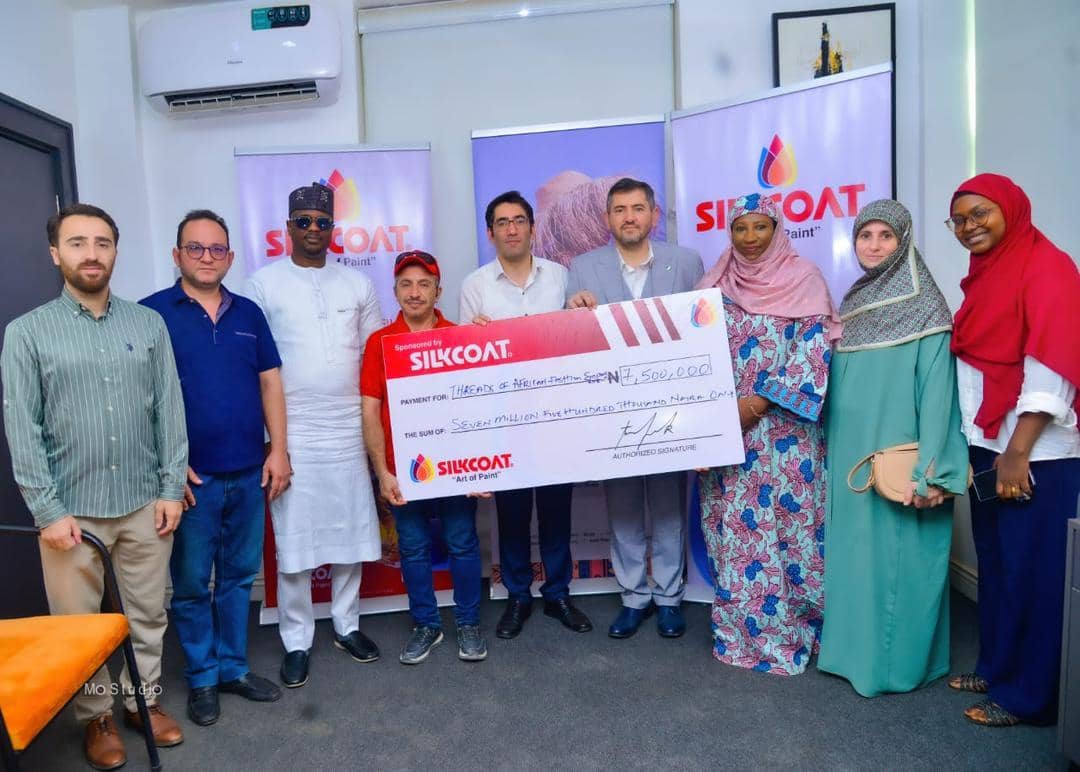
A Turkish-based manufacturing company, Silkcoat, has entered into a strategic partnership with Threads of Africa Fashion Week, a Nigerian-owned platform that coordinates fashion industry stakeholders, to support grassroots empowerment within Nigeria’s creative sector. As part of the collaboration, the company has committed ₦7.5 million to train and support emerging female fashion designers across the country.
The donation was formally announced during a presentation ceremony held in Abuja, where industry leaders, development partners, and fashion stakeholders gathered to witness the initiative aimed at strengthening women-led enterprises in the fashion industry.
Speaking at the event, Mr. Baris Yerlikaya, Marketing and Sales Manager of Silkcoat Nigeria, said the intervention aligns with the company’s broader corporate social responsibility agenda and its commitment to inclusive economic growth in Nigeria.
According to Yerlikaya, the programme is designed to provide skills development, capacity building, and sustainable business startup support for five grassroots female designers, enabling them to transition from talent to profitable.
Yerlikaya described Nigeria as Africa’s largest economy and one of the continent’s most influential fashion markets, noting that its creative sector has the potential to compete globally when adequately supported.
“Nigeria remains the giant of Africa and a major fashion trade hub with enormous creative talent. With the right investment and capacity building, Nigerian designers can stand shoulder to shoulder with their global counterparts,” he said.
He explained that Silkcoat has operated across Africa since 2000 and has consistently prioritized value-driven partnerships in countries where it conducts business.
“Our presence in Africa has always been guided by the belief that businesses must contribute meaningfully to local economies. This belief informed our decision to support the 2025 Threads of Africa Fashion Week and empower emerging designers,” Yerlikaya stated.
The Silkcoat representative revealed that the ₦7.5 million contribution was structured as a direct empowerment intervention, rather than a ceremonial sponsorship. Each beneficiary, he said, would receive an estimated ₦1.5 million covering professional training, tools, and the foundational resources required to establish a functional fashion enterprise.
“We learned that it takes about ₦1.5 million for one designer to undergo professional training and successfully launch a viable fashion business. That is why we chose to support five women through this targeted empowerment programme,” he explained.
Yerlikaya added that the initiative forms part of Silkcoat’s broader focus on empowering women and girls as drivers of creativity, social inclusion, and economic independence.
Beyond the fashion initiative, Yerlikaya disclosed that Silkcoat has implemented multiple community-focused projects across Nigeria. These include the construction of over 100 water boreholes in Sokoto, Maiduguri, and Kano, aimed at improving access to clean water and supporting school attendance among pupils in underserved communities.
He also noted that the company has sponsored community football tournaments for painters in the same states, awarding ₦100,000 to participating teams as part of efforts to encourage unity, recreation, and grassroots development.
According to him, Silkcoat’s long-term vision includes attracting more Turkish investors to Nigeria, stimulating local industries, creating jobs, and contributing to sustainable economic growth.
In his remarks, Mr. Aminu Aminu, Director of Administration at Threads of Africa Fashion Week, expressed appreciation to Silkcoat for supporting grassroots female designers through what he described as a “timely and impactful intervention.”
Aminu said the ₦7.5 million fund would be used to refine skills, provide equipment, brand the designers, and position them for international exposure, partnerships, and investment opportunities.
“The selected beneficiaries will be drawn from across the country. This initiative will equip them not only with technical skills but also with the business knowledge required to thrive in competitive markets,” he said.
Aminu disclosed that the 2025 Threads of Africa Fashion Week, scheduled for the first quarter of 2026, will focus on promoting Africa’s rich cultural heritage while showcasing emerging and established designers to a global audience.
He described the event as a premier platform that connects Africa’s fashion ecosystem—from grassroots creators to top designers, fabric merchants, and styling entrepreneurs.
“The fashion week will serve as a hub for runway showcases, business networking, and cross-sector collaboration, all aimed at expanding the African fashion industry,” Aminu explained.
Aminu added that discussions are ongoing with key government institutions, including the Ministry of Art, Culture, Tourism and the Creative Economy, the Ministry of Industry, Trade and Investment, the Ministry of Foreign Affairs, and the Ministry of Interior, to ensure smooth logistics and international participation.
He further revealed that the five emerging designers would be unveiled during the event, where they would showcase their work and pitch their brands directly to foreign investors.
To strengthen credibility, Aminu said certificates of training and empowerment would be issued through government-accredited skill acquisition centers and universities, providing official recognition and boosting investor confidence in the designers’ brands.
