




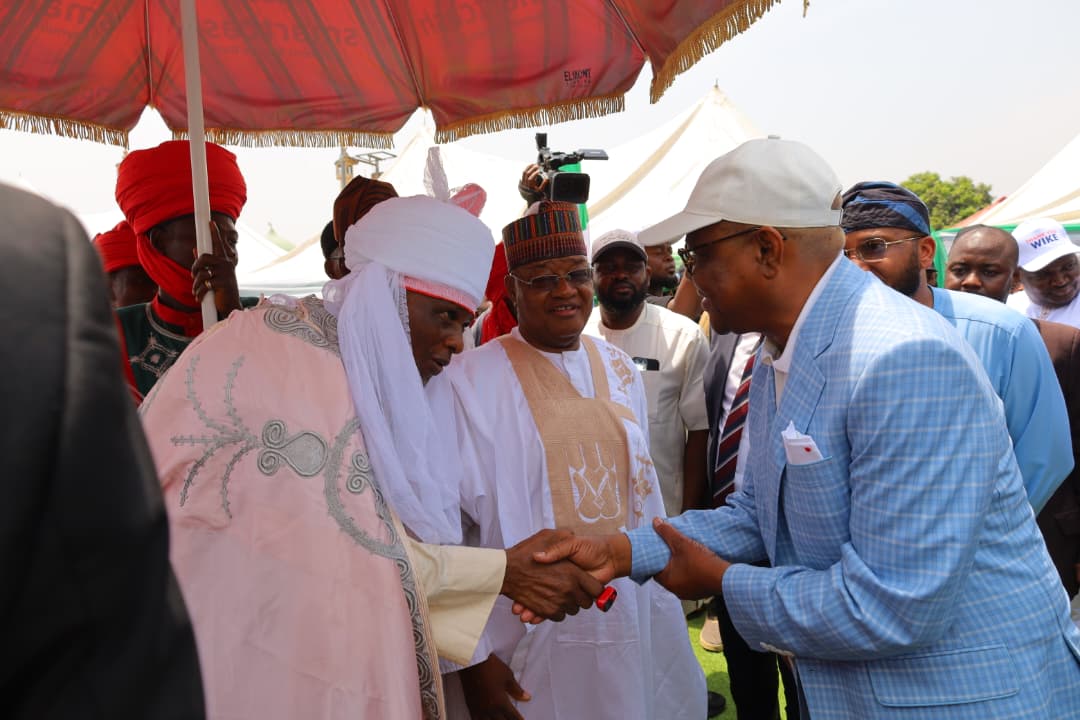
The Minister of the Federal Capital Territory (FCT), Ezenwo Nyesom Wike, has unveiled a major reform of the traditional leadership structure across the FCT, announcing the immediate elevation of traditional rulers to a higher status as part of efforts to strengthen community leadership and cultural institutions.
The announcement was made on Tuesday, March 10, 2026, during the Minister’s thank-you visit to Abaji Area Council, where he met with residents, political leaders, and traditional rulers to appreciate their support during the recent council elections.
Speaking at the gathering, the Minister announced that all Second-Class traditional rulers in the territory have now been upgraded to First-Class status. At the same time, Third-Class chiefs have been elevated to Second-Class status. According to him, the decision reflects the government’s recognition of the dedication of traditional leaders who play vital roles in maintaining peace, resolving community disputes, and preserving cultural heritage.
He explained that traditional rulers remain critical partners in grassroots governance and deserve recognition for their contributions to stability and development across communities in the capital territory.
During his remarks, the Minister also expressed appreciation to the people of Abaji for their strong support during the Area Council elections held on February 21, 2026. He noted that the community demonstrated overwhelming support for candidates aligned with President Bola Ahmed Tinubu, with results showing victories in 133 out of 135 polling units.
 According to the Minister, politics requires mutual commitment between leaders and the people. He stated that since the residents fulfilled their promise during the election, the government is equally committed to delivering meaningful development projects that will improve living conditions in the area.
In response to requests from the traditional ruler of Abaji, Adamu Baba Yunusa, and the council leadership, the Minister approved several infrastructure projects to boost development in the council.
Among the key projects is the construction of a new and modern palace for the Ona of Abaji. The Minister directed the council chairman to prepare the palace design immediately, assuring residents that the FCT Administration will fund the project.
He also promised that the government would address two major erosion sites affecting parts of the community, as well as complete an abandoned road project that has remained unfinished for years.
In addition, the Minister assured residents that the Gurara–Yangoji bridge, a major concern for commuters, farmers, and students in the area, would soon be rehabilitated to ease transportation challenges.
Another major highlight of the visit was the government’s commitment to activate the FCT University of Science and Technology in Abaji. The Minister assured residents that the institution would soon begin full academic operations under the current administration.
He explained that the university is expected to serve as an important educational centre while also boosting economic activity in the council by attracting businesses, creating jobs, and opening the community to further investment.
While calling for patience, he emphasised that the government intends to ensure the institution is properly developed before its full launch.

The Minister also praised the leadership of the Abaji Area Council Chairman, Hon. Abubakar Umar Abdullahi, describing him as a humble leader who has consistently prioritised the welfare of the people. However, he warned residents to remain cautious of politicians who only appear in communities during election periods without a genuine commitment to development.
He encouraged traditional rulers and residents to continue supporting the Federal Government’s development agenda, assuring them that more projects would be implemented across the territory.
In his remarks, the council chairman attributed his re-election to the developmental efforts of the FCT Administration, noting that Abaji had experienced increased attention from the Federal Government since the current leadership assumed office.
He said that before the current administration, the council rarely felt the federal government’s presence. Still, recent infrastructure projects and policy decisions have helped residents feel more included in the development of the capital territory.
The chairman also highlighted the electoral outcome in the council, explaining that the ruling party secured victories in all ten wards and in nearly every polling unit, an achievement he described as unprecedented in the history of the council.
The Ona of Abaji, who also serves as Chairman of the FCT Council of Traditional Rulers, commended the Minister for improving security and infrastructure in the council. He also congratulated the Etsu of Kwali for his recent elevation to First-Class status, noting that the decision reflects the government’s respect for traditional institutions.
Former FCT Senator Sidi Ali also praised the Minister’s development initiatives, describing them as transformative for communities across the Federal Capital Territory.
The visit concluded with renewed assurances from the government that more development initiatives will be implemented to improve infrastructure, education, and economic opportunities for residents of Abaji and other councils within the FCT.
