




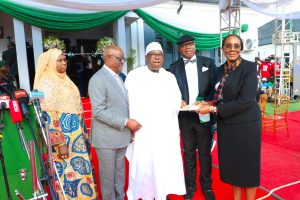
President Bola Ahmed Tinubu has commissioned 10 newly completed staff quarters at the Nigerian Law School, Bwari, with the Federal Government approving 20 additional housing units for the institution.
The President was represented at Monday’s commissioning by the Secretary to the Government of the Federation, Senator George Akume. The project, delivered by the Federal Capital Territory Administration, is intended to ease accommodation pressure for staff and support the working environment at the country’s principal institution for professional legal training.
The new development consists of 10 furnished four-bedroom bungalows, located in two sections of the Bwari campus. Five units are on the northern side of the campus and five on the western end. The project also includes paved parking areas, water supply, dedicated power infrastructure and related external works.
For staff who live and work around the campus, the project is expected to bring more than new buildings. On-campus accommodation can reduce daily travel demands, support faster access to work and help create a more stable environment for teaching, administration and other services that keep the Law School running.
In remarks delivered on his behalf, President Tinubu described the project as a strategic investment in legal education under his administration’s Renewed Hope Agenda.
He said legal education depends not only on lecture rooms and student facilities but also on the people who teach, guide and administer the system. According to him, providing decent housing for those workers is a national priority.
“The legal profession stands as the sentinel of our democracy, the very guardian of the rule of law,” the President said. “But we must ask ourselves: how can we expect the next generation of legal minds to be properly moulded if the teachers, the instructors, and the administrators who shape them are left without decent, dignified shelter?”
The President linked the project to the wider effort to strengthen public institutions in the Federal Capital Territory. He also credited the FCTA’s removal from the Treasury Single Account arrangement with giving the administration greater financial flexibility to execute infrastructure projects more quickly.
That is the Federal Government’s position. The long-term impact of the policy will be measured by the timely completion, maintenance and public value of projects delivered across the FCT.
Tinubu also commended the FCT Minister, Nyesom Wike, for acting on the Nigerian Law School’s Certificate of Occupancy. According to the FCTA, the minister waived the processing fees and directed that the title document be issued after the School had operated in Bwari for years without formal title documentation.
The biggest new announcement from the event came from Wike, who said President Tinubu had approved 20 additional staff housing units for the Law School.
Wike said the approval followed a request by the Director-General of the Nigerian Law School, Dr. Olugbemisola Titilayo Odusote, concerning older and deteriorating accommodation facilities on the campus.
He recalled the President’s response to the request: “Why didn’t I do more for them?” Wike said he replied that funding was the limitation, before receiving the instruction to announce “that we are going to do 20.”
The proposed units would add to the 10 quarters commissioned on Monday. The FCT minister also said the approval comes alongside the ongoing construction of two 300-bed student hostels at the Bwari campus, a development that could expand residential capacity for students when completed.
The timetable, cost and contractor details for the additional 20 units were not stated in the press release. Those details will matter as the project moves from approval to execution.
The Nigerian Law School occupies a central place in Nigeria’s legal education system. It was established in 1962 and moved its headquarters to Bwari in 1997. The School provides the vocational training required for law graduates before they can progress to professional practice.
Its academic work depends on lecturers, administrators, hostel personnel, library workers, security staff and other teams who keep a large national institution functioning. Improving staff accommodation does not solve every challenge facing the School, but it addresses a practical welfare need that can affect morale, staff retention and the day-to-day delivery of services.
Dr. Odusote described the Nigerian Law School as a “critical national asset” and said the homes would directly address accommodation shortages while enabling staff to live with dignity on campus.
Chief Emeka Ngige, SAN, Chairman of the Council of Legal Education, also said improved accommodation could help institutions retain skilled academic and administrative personnel.
His point reflects a wider concern among public institutions: modern facilities alone are not enough unless they are matched by working conditions that encourage experienced professionals to remain in service.
For Bwari residents, the project adds to the visible public infrastructure within one of the FCT’s major education and institutional corridors. It also puts attention on the need for authorities to maintain completed projects, provide reliable water and electricity and deliver the promised follow-up housing on schedule.
The 10 completed homes are now a tangible addition to the Nigerian Law School campus. The next test will be whether the planned 20 additional units and the two student hostels are completed to the same standard and within a clear timeframe.
For the Law School, the intervention offers an opportunity to improve staff welfare and campus functionality. For the FCTA and Federal Government, it creates a measurable commitment: staff, students and residents can track whether the additional housing, hostels and associated infrastructure are delivered as announced.
As the government continues to prioritise infrastructure in the FCT, the Nigerian Law School project shows why public investment matters most when it improves the conditions in which national institutions serve the people.
Watch the Video
