




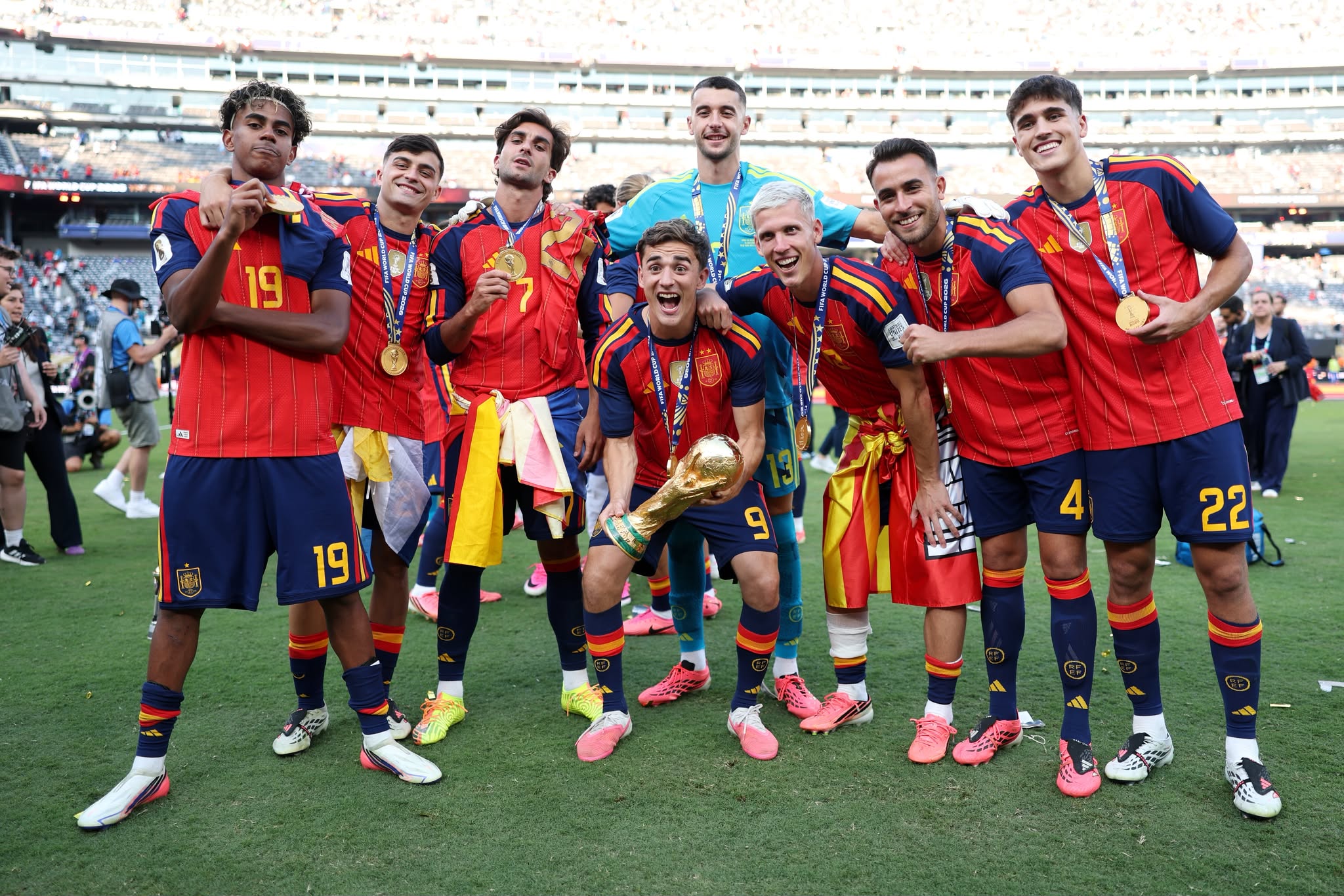
Spain have returned to the summit of world football, defeating defending champions Argentina 1–0 after extra time in the 2026 FIFA World Cup final.
Substitute Ferran Torres scored the decisive goal in the 106th minute, reacting quickly to Nico Williams’ headed pass before firing a left-footed effort beyond Argentina goalkeeper Emiliano Martínez. The victory gave Spain its second men’s World Cup title, 16 years after Andrés Iniesta’s famous extra-time winner against the Netherlands in South Africa.
Torres’ winning goal also completed an extraordinary tournament for FC Barcelona, with eight players from the Catalan club becoming world champions.
The final remained goalless throughout regulation time despite Spain controlling possession and creating most of the attacking opportunities.
Argentina defended in numbers and attempted to frustrate Luis de la Fuente’s technically gifted side. However, the defending champions suffered a major setback during stoppage time when Enzo Fernández received a second yellow card, leaving Argentina with 10 players for extra time.
Spain continued to apply pressure and eventually found the breakthrough. Williams kept a long delivery alive with a header into the penalty area, allowing Torres to finish powerfully beyond Martínez.
It was Torres’ first goal of the tournament, but it arrived at the most important moment possible. The Barcelona forward had entered the match as a second-half substitute before becoming the player who delivered Spain’s second World Cup trophy.
The goal also continued Barcelona’s remarkable connection with Spain’s World Cup history. Iniesta, another Barcelona player, scored the country’s winning goal in the 2010 final. Sixteen years later, Torres repeated the achievement on football’s biggest stage.
Barcelona confirmed that Joan Garcia, Eric Garcia, Pau Cubarsí, Gavi, Pedri, Dani Olmo, Ferran Torres and Lamine Yamal were the club’s eight representatives in Spain’s victorious squad.
Their achievement matched Barcelona’s record for the highest number of its players to win the men’s World Cup in a single tournament. The previous record was established in 2010, when Spain’s historic team contained several influential Barcelona players.
Barcelona’s involvement was not limited to the final. Ten players connected to the club reached the semi-finals, making Barça the most represented club at that stage of the competition, ahead of Atlético Madrid and Arsenal.
The final also demonstrated the continuing influence of Barcelona’s La Masia academy. Nine academy graduates were included across the Spanish and Argentine squads, including younger Spanish internationals and former Barcelona captain Lionel Messi.
Spain stars Yamal and Cubarsí both developed at La Masia before receiving their senior Barcelona debuts as teenagers. Their progression from youth football to a World Cup final reflects the value of giving talented young players structured coaching and early opportunities at the highest level.
The celebration captured in the accompanying photograph therefore represents more than one national team’s success. It highlights the results of long-term player development, academy investment and confidence in young footballers.
Argentina entered the final hoping to become the first country since Brazil in 1962 to retain the men’s World Cup.
However, Lionel Scaloni’s team struggled to develop meaningful attacking momentum. Spain’s control of the ball restricted Argentina’s opportunities, while Messi was closely watched by the Spanish defence.
The defeat denied Argentina a second consecutive title and could also prove to be Messi’s final appearance at a World Cup. The 39-year-old former Barcelona captain reached another final but could not replicate the success Argentina experienced in Qatar four years earlier.
Messi’s participation added another layer to the Barcelona story surrounding the final. The Argentine legend faced a Spanish generation that included players developed at the same football institution where he established himself as one of the sport’s greatest performers.
For Nigerian football followers, Spain’s success offers lessons beyond the excitement of another major international tournament.
The performances of Yamal, Cubarsí, Pedri and their teammates demonstrate what can happen when young talent is supported by effective academies, qualified coaches and a clearly defined football philosophy.
Nigeria has repeatedly produced naturally gifted players. However, Spain’s achievement shows that talent becomes more valuable when it is developed through a consistent system from youth football to the senior national team.
Investment in local academies, improved coaching education, regular youth competitions and better pathways into professional football could help Nigeria build more competitive teams over the long term.
Spain’s second World Cup title will ultimately be remembered for Torres’ extra-time winner. But Barcelona’s contribution gives the victory an additional significance.
Eight Barça players became world champions, La Masia’s influence was visible across both finalists, and a new generation emerged on football’s biggest stage. Spain lifted the trophy, but Barcelona’s fingerprints were present throughout the historic triumph.
