




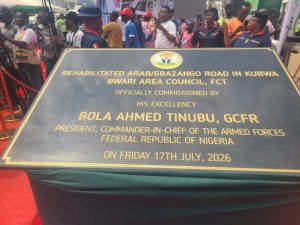
Residents of Kubwa received a major transport boost on Friday, July 17, 2026, as President Bola Ahmed Tinubu commissioned the reconstructed 4.2-kilometre Arab/Gbazango Road in Bwari Area Council, concluding the Federal Capital Territory Administration’s latest 31-project commissioning and flag-off programme.
The road links the Outer Northern Expressway with Liberty Junction in the Byazhin area and serves a busy part of Abuja’s suburban belt. For communities that have faced difficult commutes, flooding and congestion, the reconstruction is expected to improve daily movement and make homes, businesses and transport facilities easier to reach.
Tinubu, represented by House of Representatives Speaker Tajudeen Abbas, said the project reflected a policy of extending public investment beyond Abuja’s high-profile central districts. He maintained that satellite towns and outlying communities should receive infrastructure comparable to that available in the city centre.
The ceremony also allowed the FCTA to promote its wider road-building record. Yet the project’s lasting value will depend less on speeches than on durable construction, functioning drains, reliable streetlights, routine maintenance, and the delivery of other services requested by residents.
According to the FCTA, the reconstructed route is a 4.2-kilometre dual carriageway running from ONEX to Liberty Junction. The contract was awarded to Zeberced Nigeria Limited on November 21, 2025, and officials said it was completed within the agreed-upon period, including streetlights.
The government expects the road to reduce pressure on the Kubwa axis and improve connections between residential areas and major transport routes. Tinubu said better access could shorten travel time, support commerce and help emergency and security services reach communities faster.
Abdulkadir Zulkiflu, coordinator of the Satellite Towns Development Department, also said improved access could attract more passengers to nearby railway facilities. That potential benefit will depend on safe connecting roads, dependable public transport and effective traffic management around the corridor.
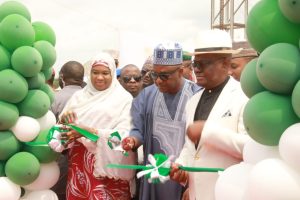
For residents, the road’s importance is practical rather than ceremonial. Nnamdi Ezeabasirim, chairman of the Arab Road Residents Association, described it as an investment in dignity, safety and opportunity. The community’s request for potable water, however, showed that roads are only one part of the infrastructure needs facing expanding suburban neighbourhoods.
FCT Minister Nyesom Wike said the administration had awarded 317 kilometres of roads in satellite towns since Tinubu took office in May 2023. He said 221 kilometres had been completed and 96 kilometres remained under construction, stressing that the figures excluded major projects delivered in Abuja’s city centre.
Wike challenged critics to disprove the figures publicly and said he would resign if the claims were shown to be false. His remarks placed the road programme at the centre of the administration’s political performance argument, with completed projects presented as a response to opposition criticism.
The numbers are substantial, but they remain claims by the administration and should be supported by accessible project lists, contract details, completion certificates and costs. The Arab/Gbazango Road statement named the contractor and award date but did not disclose the contract value, limiting the public’s ability to assess value for money from the announcement alone.
Wike also said the Apo–Karshi and Bwari–Kubwa roads would be completed before the end of 2026. Those projects will provide another test of the FCTA’s delivery timetable because they affect communities that have long faced difficult access and extended travel times.
Although the project is in Abuja, the issues it addresses are familiar across Nigeria. Poor urban and suburban roads increase transport costs, damage vehicles, delay workers, and restrict access to shops, markets, schools and health facilities. Flooded or poorly lit routes also create safety risks for pedestrians and motorists.
Kubwa illustrates Abuja’s continuing expansion beyond its planned central districts. As more workers and families settle in satellite towns, the quality of connecting roads increasingly affects productivity across the capital. Reducing delays on a major residential corridor can therefore produce benefits beyond the immediate neighbourhood.
The project also carries a wider message about balanced development. Nigerians have frequently criticised governments for concentrating quality infrastructure in elite districts while fast-growing outskirts struggle with poor roads, water shortages and limited services. Investment in satellite communities can reduce that gap when projects are transparent, properly maintained and based on local priorities. The administration has said community consultation is part of its process for selecting projects in the FCT.
The water request raised at the ceremony is therefore important. Wike directed the relevant FCT official to address the community’s potable water problem. Residents will judge the intervention by whether reliable water reaches homes, not simply by the instruction issued at the event.
The completion of the Arab/Gbazango Road is a welcome development for Kubwa residents, particularly if it delivers smoother travel, better drainage and safer night-time movement. The next test is whether the road retains its quality through rainy seasons and whether faulty lights, blocked drains or damaged sections are repaired promptly.
Read Also
*Tinubu Commissions 4.2km Arab/Gbazango Road in Kubwa as FCTA Touts 221km Road Drive
*Tinubu Opens 10 Staff Quarters at Nigerian Law School, Approves 20 More Housing Units
Tinubu and other officials urged residents to protect the infrastructure from vandalism and keep drainage channels clear. Community responsibility matters, but maintenance cannot be transferred entirely to residents. The FCTA must provide inspections, drainage clearing, traffic management, and timely repairs as part of the investment.
The political language surrounding the commissioning should not distract from that standard. Roads do not succeed merely because they are inaugurated or cited in partisan debates. Their performance should be measured by durability, reduced travel time, improved safety, transparent spending and the economic opportunities they create.
For Nigerians, the Kubwa project is a test of whether infrastructure promises can become sustained improvements in everyday life. The new road is a visible achievement, but its full legacy will be determined by maintenance, accountability and completion of the wider network needed to connect Abuja’s suburban communities.
Watch The Video:- I WILL RESIGN AS A MINISTER OF FCT IF Barr Ezenwo Nyesom Wike – YouTube
