




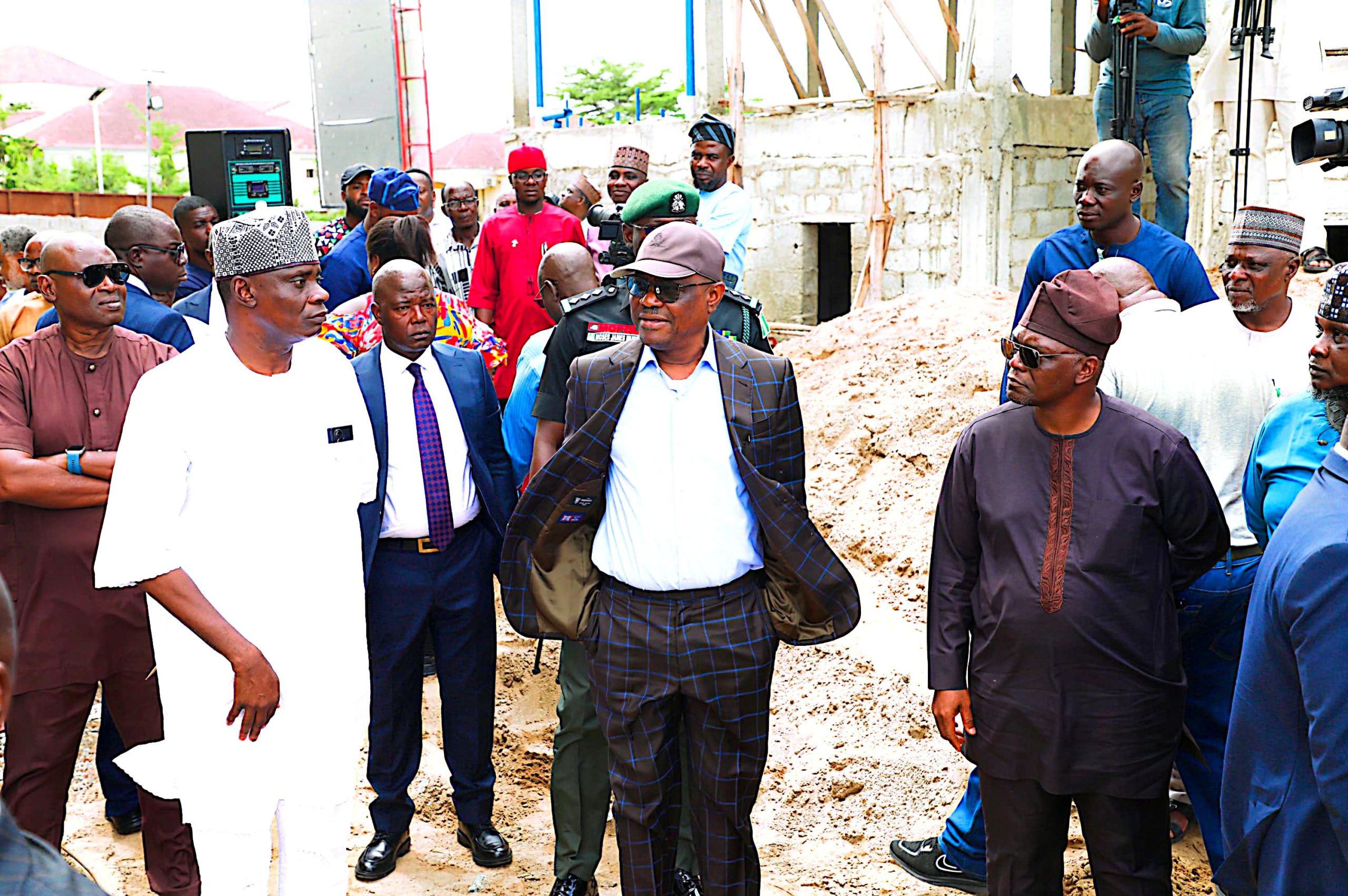
The Federal Capital Territory Administration (FCTA) says it will commission at least 18 major infrastructure projects as part of activities marking President Bola Ahmed Tinubu’s third anniversary in office, while also launching an investigation into the recent building collapse in Abuja’s Gudu District that claimed four lives.
FCT Minister Nyesom Wike disclosed this on Monday, May 18, 2026, after inspecting several ongoing infrastructure projects and visiting the site of the collapsed three-storey building in Gudu.
According to the minister, the projects scheduled for commissioning are designed to improve transportation, economic development and public services across the Federal Capital Territory.
Wike inspected the construction of a major road and bridge connecting Abuja’s Central Business District to Wuse District, a strategic project expected to ease traffic congestion and improve connectivity within the city. He commended contractor Levant Nigeria Limited for the progress made on the project and urged the company to complete the work earlier than scheduled.
The minister also visited the Mabushi bus terminal road project being handled by Setraco, as well as the bridge interchange connecting Jahi and Gwarimpa, which is under construction by CBC Global.
“We are making significant progress,” Wike said. “By the end of May, we should have a clearer figure, but the projects lined up for commissioning will not be fewer than 18. These are projects that directly impact residents and contribute positively to the economy of the FCT.”
He explained that the infrastructure projects form part of the administration’s broader plan to modernise Abuja, improve transportation networks and support urban development in satellite communities and the city centre.
The minister stressed that the ongoing projects are aimed at improving residents’ daily lives through better roads, improved transportation access, and public infrastructure.
While discussing development efforts, Wike also addressed the tragic collapse of the three-storey building in Gudu, which reportedly killed four people and injured nine others over the weekend.
Describing the incident as unfortunate and painful, the minister announced the immediate sealing of the property and directed the Department of Development Control to establish a panel to investigate the cause of the collapse.
He disclosed that one engineer on the project had already been arrested, while efforts were underway to apprehend the developer.
“It is a very tragic situation,” Wike said. “The government has a responsibility to protect lives and property, and we cannot ignore incidents like this. The premises have been sealed, and a full investigation will determine what went wrong.”
The minister emphasised the importance of strict compliance with building regulations and warned developers against bypassing official supervision during construction.
According to him, many building collapses can be prevented if developers cooperate fully with government agencies and adhere to approved engineering and safety standards.
“When constructing buildings of this magnitude, developers must allow proper supervision at every stage,” he said. “Soil testing, quality control and the use of approved materials are critical to ensuring structural stability.”
Wike also criticised attempts to politicise enforcement actions taken by government agencies, noting that officials are sometimes unfairly attacked whenever they try to enforce compliance with construction guidelines.
“Instead of understanding why government intervenes, some people resort to blackmail against officials carrying out their duties,” he added.
The minister maintained that preventing future building collapses requires stronger adherence to safety regulations and responsible construction practices.
At the collapse site, Director of the Development Control Department, Tpl. Sunusi Bashir Madaki provided preliminary findings on the incident.
According to Madaki, the structure may have collapsed because part of the foundation was built over a concealed well that had previously been filled with debris and clay.
He explained that the site itself consisted largely of reclaimed land from dredged waterways, which made the soil condition unstable.
“There was a hidden local well at the site,” Madaki said. “Columns of the building were placed directly over the filled-up pit, and the depth of the column foundation was shorter than the depth of the well. That structural weakness contributed to the collapse.”
The preliminary report has raised fresh concerns about construction safety and urban planning standards in rapidly developing parts of Abuja.
Urban development experts say proper soil testing and strict enforcement of engineering standards are essential in preventing future structural failures, especially in areas built on reclaimed or unstable land.
The FCTA has, in recent months, intensified efforts to improve infrastructure and regulate urban development across the capital city. The administration says the combination of road expansion, transportation upgrades and stronger development oversight is intended to support Abuja’s growing population and economic activity.
With several large-scale projects nearing completion ahead of the president’s anniversary celebration, the administration says it remains focused on delivering infrastructure that improves mobility, strengthens public safety and enhances the quality of life for residents across the Federal Capital Territory.
