




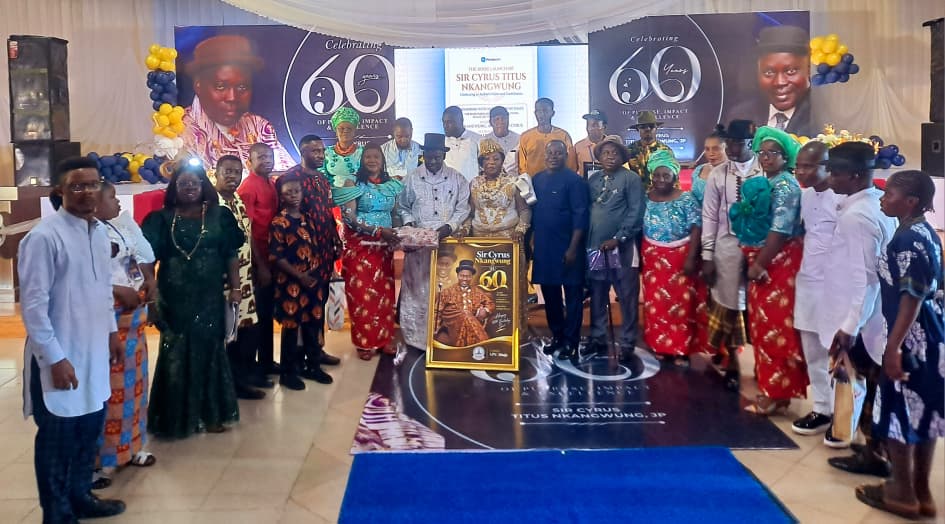
At a time when financial success is often measured by what a person owns, earns, or displays, retired civil servant Cyrus Nkangwung offers a different measure of achievement: a life’s value can also be seen in the people it serves and the legacy it leaves behind.
Speaking in Abuja during his 60th birthday celebration, retirement thanksgiving, and the presentation of his autobiography, Nkangwung urged young civil servants to resist the pressure to become wealthy quickly and instead invest in integrity, personal development, and service to humanity.
For him, retirement is not simply the end of a career. It is an opportunity to reflect on years of work, the values that shaped the journey and the lessons that can benefit those coming behind.
Nkangwung argued that financial wealth should not be the only measure of a successful life. According to him, the time spent helping others and making meaningful contributions to society can become a more enduring legacy than material possessions. “Money is not everything, but whatever you have done in the sense of time will stand, and that’s what people will say something about.”
He encouraged young people to invest in humanitarian service, stressing that the impact of helping others can outlive material possessions. “Invest in humanitarian services; those are the things that matter.”
Faith also featured prominently in his reflections. Nkangwung said God is the source of wealth, and everything people possess, adding that dedication to God should take priority over the pursuit of material gain.
His message comes amid the wider pressure many young Nigerians face to achieve financial independence quickly.
For young professionals entering public service, career advancement requires time and experience, while economic and social pressures can make shortcuts and questionable opportunities appear attractive.
Nkangwung cautioned that decisions made for immediate benefits can affect an individual’s career and future.
He specifically warned young people against cultism and wrongdoing undertaken for protection, influence or material benefits. “This life is not about what you get now. Invest in yourself and be patient with God.”
He also stressed personal responsibility, saying individuals must consider the long-term consequences of their choices. “The destiny of any person can only be destroyed by himself.”
His advice therefore goes beyond avoiding wrongdoing. It calls on young civil servants to look beyond immediate gratification and build careers based on patience, competence and character.
Personal development was another major theme of Nkangwung’s message.
He urged younger civil servants to build professional skills, deepen their knowledge, maintain integrity, build positive relationships, and learn from experienced people.
In public service, these qualities matter because the decisions and conduct of public officers can affect institutions and citizens.
Nkangwung’s own retirement provided the setting for this message. At 60, he was marking both a personal milestone and the transition from active public service to another phase of life.
Rather than regarding retirement as an endpoint, he described it as another opportunity to contribute to society.
His autobiography, presented during the celebration, documents his experiences and years in public service while offering reflections for younger generations.
The book therefore serves not only as a record of his career but also as an attempt to preserve lessons from his journey.
One of the major lessons Nkangwung said he learnt from public service was the importance of sincerity.
He said he had always believed in speaking the truth, including when dealing with people close to him.
For public servants, integrity extends beyond personal relationships. Trust is essential to effective institutions and to the relationship between government and citizens.
Nkangwung’s reflections therefore connect personal character with professional responsibility. His message suggests that a successful public service career should be measured not only by position attained or material benefits acquired, but also by the trust earned and the lives positively influenced.
At the celebration, Rt. Rev. Duke Akamisoko, Bishop of the Diocese of Kubwa, encouraged Nkangwung and his well-wishers to reflect on the value of time.
The bishop observed that 60 years represented approximately 21,900 days and about 525,000 hours, reminding the gathering that time already spent cannot be recovered. “History is divided into three parts and the life of a man is divided into three parts, you have the past, the present, and the future.”
Akamisoko urged the celebrant to look at the past with gratitude rather than regret while making deliberate use of the present.
He noted that people sometimes focus on what they have not achieved or what they do not possess while overlooking the blessings and opportunities already available to them.
The bishop also acknowledged that difficult experiences form part of a person’s history but should not determine their entire future.
Referencing Romans 8:28, he encouraged Nkangwung to draw lessons from his experiences and use them constructively in the next phase of his life.
For Nkangwung’s family, the occasion provided an opportunity to highlight the personal qualities they associate with him.
His wife, Mrs Grace Nkangwung, a Comptroller of the Nigeria Immigration Service, thanked God for enabling her husband to serve the nation and complete his active career.
She described him as a philanthropist whose willingness to sacrifice for others defined his character.
Grace also encouraged women to support their husbands through prayer, financial assistance and other forms of encouragement, saying peace at home can positively influence a person’s activities outside the home.
Nkangwung’s first son, Awajiigbana Nkangwung, speaking on behalf of his siblings, described his father as diligent, selfless and sacrificial.
He said he had watched his father serve others in public service, at home and in the church. “He is a role model to me. I hope to reach his level and someday exceed that point.
Former colleagues also recalled his humanitarian character.
Celestine Chowuba, representing the National Oil Spill Detection and Response Agency’s Gombe Office, described Nkangwung as a philanthropist who sacrificed personal interests for humanity.
Another former colleague, Raph Ngnam, described him as a gentleman who had lived a sacrificial and exemplary life.
Nkangwung’s 60th birthday and retirement celebration ultimately became more than a personal milestone. It provided an opportunity to consider what remains after a person leaves formal employment.
A position changes hands and a career eventually ends, but relationships built, people helped, values demonstrated, and knowledge transferred can continue beyond retirement.
That is the central message running through Nkangwung’s reflections.
His advice is not that financial success is unimportant, but that the pursuit of money should not come at the expense of character, professional development, faith or service to others.
As he begins a new chapter, his autobiography becomes part of that legacy—preserving his experiences and the lessons he hopes younger generations will carry forward.
The celebration in Abuja therefore marked both the completion of one professional journey and the beginning of another form of service, built on experience, reflection and a commitment to inspire those coming behind.
