




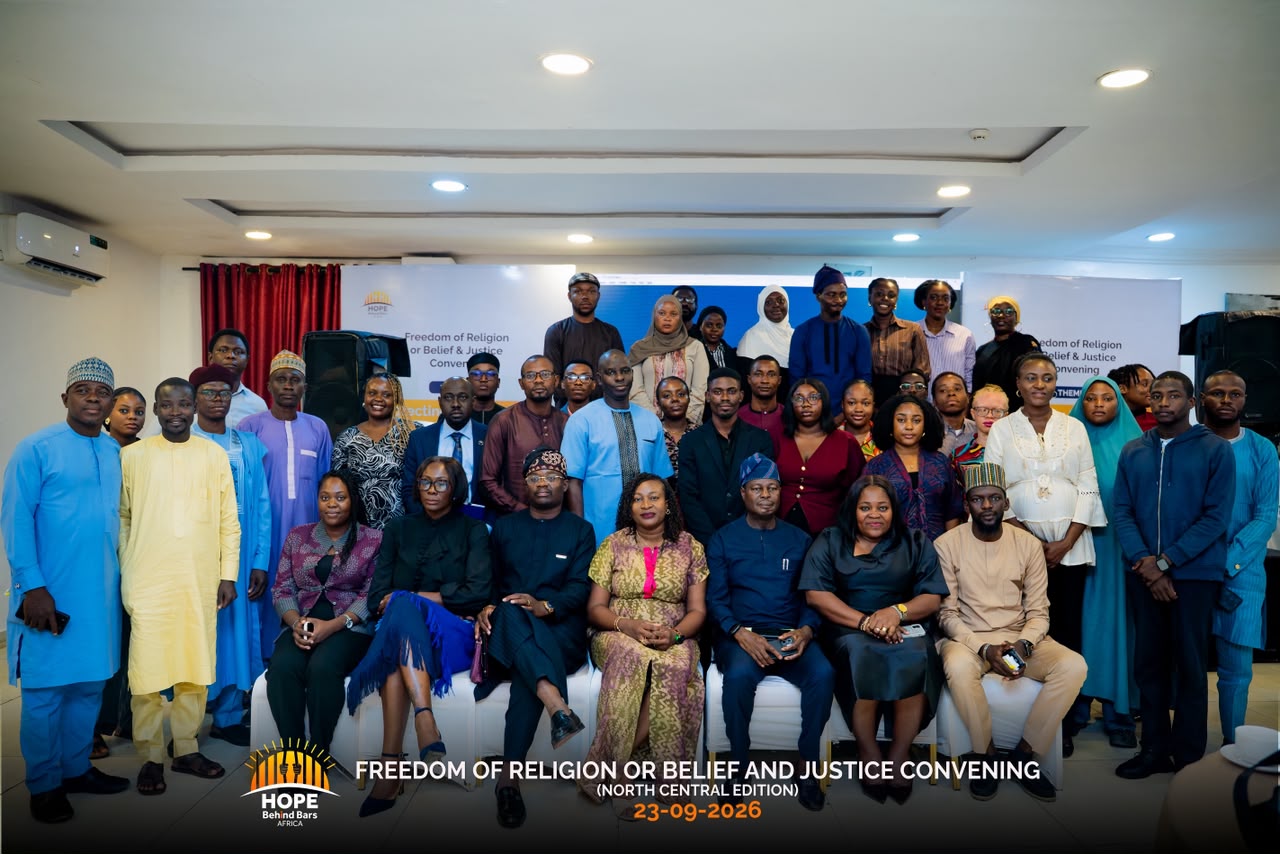
Calls for stronger criminal justice institutions and equal enforcement of the law have emerged from a gathering of legal experts, faith leaders, civil society organisations and human rights advocates in Abuja, as stakeholders examined how Nigeria can better protect freedom of religion or belief and freedom of expression.
The call was made at the North Central FoRB and Justice Convening, organised by Hope Behind Bars Africa (HBBA) with support from the National Endowment for Democracy. The meeting, themed “Protecting Freedom of Religion or Belief in Nigeria: From Dialogue to Action,” brought together representatives from the justice sector, religious communities, the media, civil society, and government institutions.
The discussions focused on a central question: how can rights guaranteed by law be translated into effective protection for individuals and communities?
HBBA Executive Director, Mrs Funke Adeoye, said freedom of religion or belief is a fundamental right that allows individuals to hold, change, express and practice their beliefs without discrimination or undue restriction.
She argued that religious freedom cannot be considered in isolation from criminal justice, civic rights, community relations and the protection of vulnerable groups.
According to Adeoye, HBBA deliberately designed the convening to move beyond discussion and to encourage practical measures that strengthen accountability and rights protection.
“This event is also intended to amplify diverse perspectives on FoRB and draw greater public attention to the need for sustained dialogue, accountability and action in protecting fundamental rights.”
She called for greater cooperation among government institutions, faith communities, civil society groups, lawyers and journalists to promote equal protection under the law.
The discussion comes as Nigeria continues broader efforts to strengthen its justice system. In April 2026, the Federal Ministry of Justice unveiled National Minimum Standards and a Harmonised Restorative Justice Training Curriculum aimed at improving implementation of criminal justice reforms.
Legal expert Ms Tsema Ede urged authorities to guard against the arbitrary use of broadly worded laws, including provisions on public disturbance and blasphemy, whose application could restrict minority expression or dissent.
She called for neutral mechanisms to resolve religious tensions, stronger institutional safeguards against discrimination, and balanced legislative measures on religious freedom.
“There is an urgent need for a healthy and balanced legislative intervention in the area of religious freedom in Nigeria.”
Ede said that security and national unity ultimately depend on adherence to the rule of law and equal protection, rather than on the selective application of legal provisions.
Her comments reflect a wider debate surrounding Nigeria’s legal framework, where constitutional protections for freedom of religion coexist with different legal systems and state-level provisions. The 1999 Constitution protects freedom of thought, conscience and religion, while Nigeria’s legal system also accommodates Sharia-based courts in certain states.
Alex James, Executive Director of Rivers in the Desert Initiative, called for deeper examination of the relationship between Sharia law, freedom of religion and freedom of expression.
He questioned how matters traditionally regarded as family or civil issues can become criminal matters and said the distinction has implications for fundamental rights.
James also stressed the importance of addressing processes through which individuals may be indoctrinated into violent or harmful beliefs.
Meanwhile, Rev. Fr. Barkindo Atta, Executive Director of the Kukah Centre, called for clear laws governing hate speech and incitement and urged authorities to apply them consistently, regardless of a person’s religion, ethnicity, social status or political position.
“Hate speech and incitement should be governed by agreed laws. It should not matter who you are in the society; if you violate these laws, you should face the consequences so that we are not profiled.”
His position highlights the challenge of balancing freedom of expression with the need to address speech that may contribute to violence, discrimination or public disorder.
HBBA board member Stanley Ibe also called for effective and impartial implementation of laws protecting freedom of religion or belief.
The range of participants reflected the broad nature of the issue. Representatives included the Kukah Centre, NASFAT, YALI Abuja, Christian organisations, Goodluck Jonathan Foundation, HumAngle, Digicivic Initiative, Rivers in the Desert Initiative, Code for Africa, PAR-RVP Initiative, the National Human Rights Commission, Nigerian Bar Association, Global Rights, Paradigm Initiative Nigeria and TechHer.
The convening comes at a time when Nigeria is pursuing wider justice-sector reforms, including efforts to improve coordination among courts, law enforcement, correctional institutions and legal aid providers.
For the stakeholders gathered in Abuja, the challenge is therefore not simply creating more laws. It is ensuring that existing rights and legal safeguards are applied fairly and consistently.
The broader message from the meeting was that religious freedom, freedom of expression, public safety and justice are interconnected. Strengthening one without addressing weaknesses in the others may leave vulnerable individuals and communities without effective protection.
The task now is to translate dialogue into institutional practices that promote accountability, equal treatment and respect for fundamental rights across Nigeria.
