




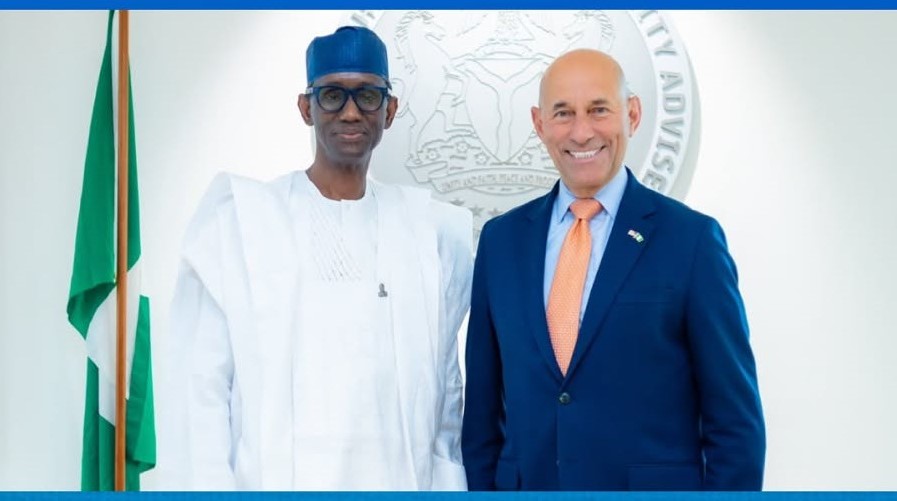
Nigeria and the United States have renewed their commitment to stronger security cooperation as the National Security Adviser, Mallam Nuhu Ribadu, received a high-level American delegation led by the newly appointed United States Assistant Secretary of State for African Affairs, Frank Garcia.
The meeting, held in Abuja on Monday, formed part of Garcia’s first official visit to Nigeria since assuming office. It also provided an opportunity for both countries to review progress under the Nigeria–US Joint Working Group and discuss shared security priorities at a time when Nigeria continues to confront terrorism, banditry, kidnapping and other violent threats.
According to the official communication shared after the meeting, Ribadu said the engagement strengthened the long-standing partnership between Nigeria and the United States and reaffirmed both countries’ commitment to deeper dialogue and practical cooperation.
“In consolidating the gains of our partnership with the United States, I received a high-level delegation led by the new Assistant Secretary for African Affairs, Frank Garcia, on his first official visit to Nigeria since assuming office,” Ribadu said.
He added that the meeting assessed progress under the Joint Working Group and restated the shared commitment of both nations to stronger dialogue, cooperation and mutual security priorities.
Garcia’s visit to Abuja is significant because it is his first official trip to Nigeria since he was sworn into office on June 1, 2026. The visit is also part of a wider West African tour scheduled to include Côte d’Ivoire and Mali between July 11 and 18.
Nigeria was Garcia’s first stop on the regional tour, underscoring the country’s strategic role in West Africa and its importance in United States engagement with the continent. The United States Mission in Nigeria described Nigeria as a strategic partner across several sectors, including trade, security, and shared prosperity.
Beyond the meeting with Ribadu, reports indicate that Garcia also held engagements with other Nigerian officials, including the Minister of State for Foreign Affairs, Sola Enikanolaiye, and the Minister of Communications, Innovation and Digital Economy, Bosun Tijani.
Nigeria and the United States have maintained long-running security relations, especially in the areas of counterterrorism, intelligence cooperation, military support, training and diplomatic engagement.
In recent months, security discussions between both countries have intensified. The Joint Working Group has become one of the platforms through which both sides review cooperation and coordinate areas of shared concern. These concerns include terrorism, violent extremism, the protection of vulnerable communities and broader regional stability.
The United States has also expressed concern over attacks by extremist groups and violence affecting religious and vulnerable communities in Nigeria. In a statement after the latest meeting, the US Mission said both countries reviewed progress under the Joint Working Group and restated their resolve to hold ISIS and perpetrators of violence accountable.
For Nigeria, the meeting comes at a critical time. Security remains one of the country’s biggest national challenges, with communities in different regions affected by insurgency, armed attacks, kidnappings and rural violence. While Nigerian security agencies continue operations across the country, international cooperation remains important for intelligence sharing, equipment support, training and diplomatic coordination.
For ordinary Nigerians, security cooperation is not just a diplomatic issue. It affects safety, community stability, investment, education, farming, transport and the ability of citizens to live without fear.
When insecurity rises, the impact is felt in schools, markets, farms, highways and places of worship. Families are displaced, businesses struggle, food production is affected, and government resources are stretched. This is why stronger security partnerships matter.
The Nigeria–US partnership can help in several areas. Intelligence sharing can improve the ability of security agencies to track violent groups. Technical support can strengthen surveillance and response capacity. Diplomatic cooperation can help Nigeria engage international partners more effectively. Training and equipment support can also improve the professionalism and readiness of security personnel.
However, cooperation must be carefully managed. Nigerians will expect any partnership with a foreign government to respect national sovereignty, protect citizens’ rights and focus on real security outcomes rather than political statements. The success of such engagements should be measured by whether they help reduce violence, improve response time and strengthen public confidence in security institutions.
The renewed security dialogue between Nigeria and the United States is a positive diplomatic step, but it is not a substitute for domestic reforms. Nigeria still needs better policing, stronger intelligence coordination, improved border control, faster justice delivery, and more accountable security operations.
Foreign partnerships can provide support, but the responsibility for protecting Nigerians remains with the Nigerian government and its security institutions.
The meeting also shows that security challenges in Nigeria are no longer viewed only as local problems. Instability in Nigeria affects West Africa, trade routes, migration, humanitarian conditions and international security interests. This explains why Washington continues to engage Abuja on counterterrorism and regional stability.
At the same time, Nigerians will be watching for practical results. Diplomatic visits and joint statements are important, but citizens want safer roads, protected communities, rescued abductees, reduced attacks and justice for victims.
The key issue now is how both countries build on the meeting. The Nigeria–US Joint Working Group is expected to remain an important channel for reviewing security cooperation and identifying areas where both sides can act together.
For Nigeria, the priority should be to turn diplomatic engagement into measurable progress. That means stronger intelligence use, better coordination among security agencies and transparent communication with citizens.
For the United States, the visit signals renewed attention to Nigeria and West Africa under Garcia’s leadership at the Bureau of African Affairs.
As Nigeria continues to face complex security challenges, the Abuja meeting between Ribadu and the US delegation represents another effort to deepen international cooperation. The real test will be whether this partnership contributes to visible improvements in the safety and security of Nigerian communities.
