




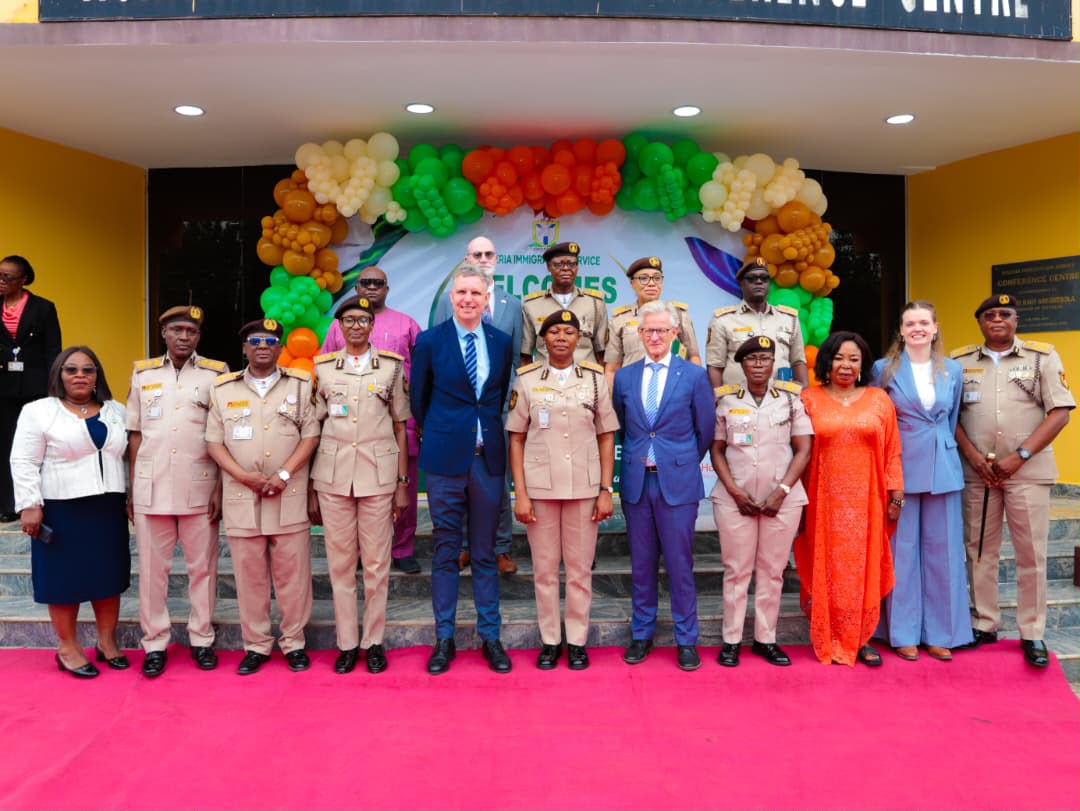
Nigeria’s drive to strengthen migration governance and modernise border management has received renewed international backing, as the Kingdom of the Netherlands reaffirmed its commitment to supporting reforms within the Nigeria Immigration Service (NIS). The pledge, announced during the handover of equipment to the NIS Hostmanship Unit in Abuja, highlights a growing partnership focused on improving migration management, border security, and institutional professionalism.
The renewed commitment comes at a critical time, as countries across Africa and Europe grapple with increasingly complex migration challenges. From irregular migration and human trafficking to border security concerns and the need for efficient travel processes, governments are under pressure to strike a balance between security and the facilitation of legitimate movement.
For Nigeria, which serves as a major transit, destination, and origin country within regional migration networks, strengthening migration governance has become an important component of national security and economic development. The Netherlands’ continued support reflects international confidence in the reforms currently underway within the NIS and the progress already achieved.
Speaking at the ceremony, Ronald Sonnemans, Charge d’Affaires of the Embassy of the Kingdom of the Netherlands in Abuja, commended the NIS for the significant improvements recorded over the past few years. He noted that professionalism, customer service, and institutional transformation have become increasingly visible within the service, describing the cooperation between Nigeria and the Netherlands as one of the most productive migration partnerships both countries have developed.
According to Sonnemans, collaboration between the NIS and the Dutch Repatriation and Departure Service has yielded positive results, particularly in migration management and the return of Nigerian nationals. He stressed that the Dutch government highly values the relationship and remains committed to sustaining it in the years ahead.
One of the key areas highlighted during the event was the success of the Hostmanship Programme, a customer-service initiative introduced within the NIS to improve interactions between immigration officers and travellers. The programme aims to create a culture of professionalism, courtesy, efficiency, and accountability at Nigeria’s airports and border posts.
Drawing on his personal experiences travelling through Nigerian airports, Sonnemans observed that many immigration officers now proudly reference their hospitality training during routine interactions. According to him, this demonstrates that the programme is not merely a policy initiative but one that has become embedded in daily operations.
The significance of this transformation extends beyond customer service. Immigration officers often serve as the first point of contact for visitors entering Nigeria. Their professionalism can influence international perceptions of the country, affecting tourism, foreign investment, and diplomatic engagement. Improved service delivery at ports of entry therefore contributes not only to operational efficiency but also to Nigeria’s global reputation.
Beyond improving traveller experiences, the partnership is also focused on strengthening Nigeria’s border management capabilities. Effective border administration remains a major priority for governments worldwide as migration patterns continue to evolve and security threats become more sophisticated.
The Netherlands’ support for initiatives such as the NIS Mobile Team Project reflects this broader objective. The project is designed to enhance operational effectiveness, improve monitoring systems, and strengthen Nigeria’s capacity to manage border activities more efficiently. These efforts are particularly important given Nigeria’s strategic location in West Africa and its extensive land and air borders.
Sonnemans also acknowledged the role of the International Centre for Migration Policy Development (ICMPD), which has worked alongside both governments to advance migration governance objectives. The organisation’s involvement has strengthened technical cooperation and capacity-building, thereby improving migration management outcomes.
Further reinforcing the importance of international collaboration, JanWillem König, Senior Advisor to the Board of Directors of the Dutch Repatriation and Departure Service (DT&V), described the Nigeria-Netherlands relationship as a strong example of how countries can work together to address shared migration challenges.
König emphasised that irregular migration and human smuggling remain global concerns that require coordinated action rather than isolated national responses. According to him, addressing these issues is in the collective interests of Nigeria, Europe, and the broader international community, particularly given the humanitarian consequences often associated with unsafe migration routes.
His remarks reflect a growing international consensus that sustainable migration management depends on partnerships, intelligence sharing, institutional reforms, and investments in professional capacity. As migration continues to shape global policy discussions, cooperation between countries has become increasingly essential for achieving long-term solutions.
A notable aspect of the partnership is its focus on human capital development. Beyond equipment donations and operational support, the Netherlands is investing in leadership and institutional capacity within the NIS.
König announced that a specialised leadership programme for senior immigration officers will commence in September and will be facilitated by Dutch experts. The initiative is expected to expose participants to international best practices in migration governance, leadership, and organisational management.
The programme also signals the Dutch government’s confidence in the NIS’s leadership and its commitment to supporting long-term institutional excellence. By strengthening leadership capacity, both countries hope to ensure that ongoing reforms remain sustainable and deliver measurable results.
Responding to the renewed support, Comptroller-General of Immigration Kemi Nandap expressed appreciation to the Dutch government and development partners for their continued collaboration. She noted that the partnership demonstrates how meaningful institutional transformation can be achieved when countries work together with sincerity, trust, and shared objectives.
Nandap reaffirmed the NIS commitment to reforms centred on professionalism, innovation, accountability, and service excellence. Her remarks align with broader efforts to modernise immigration processes, improve border administration, and enhance service delivery nationwide.
Ultimately, the Netherlands’ renewed commitment represents more than diplomatic goodwill. It is a vote of confidence in Nigeria’s ongoing migration reforms and a recognition of the progress already made. As migration challenges continue to evolve globally, sustained cooperation between Nigeria and the Netherlands is expected to play a crucial role in strengthening border security, promoting orderly migration, and building institutions capable of meeting the demands of a rapidly changing world.
At a time when effective migration governance is increasingly linked to economic growth, national security, and international cooperation, the partnership offers a model for how countries can work together to achieve lasting and meaningful reforms.
