




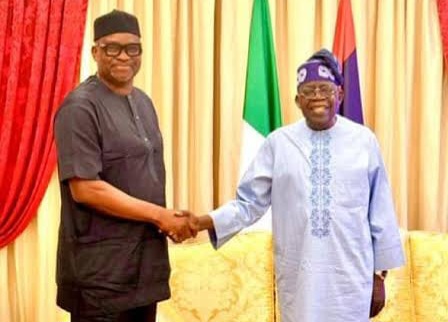
Former Ekiti Governor Ayo Fayose, retired military officers, technocrats and experienced public servants have been appointed to lead key government agencies as President Bola Tinubu continues efforts to strengthen public institutions and drive reforms across critical sectors.*
President Bola Ahmed Tinubu has approved 26 new appointments into 10 federal government agencies and commissions, a move that signals a renewed focus on governance, public sector efficiency and institutional leadership across strategic sectors of the economy.
The appointments, announced by the President’s Special Adviser on Information and Strategy, Bayo Onanuga, affect agencies responsible for electrification, wages and salaries, population management, fiscal responsibility, agriculture, housing, literacy and energy development.
Among the most notable appointments is former Ekiti State Governor Ayo Fayose, who has been named Chairman of the Rural Electrification Agency (REA), one of Nigeria’s key institutions tasked with expanding electricity access to underserved and rural communities.
Fayose’s appointment places a prominent political figure at the helm of an agency that plays a critical role in Nigeria’s energy access agenda.
The Rural Electrification Agency has become increasingly important in recent years as the federal government pursues efforts to improve electricity supply in rural communities, support economic development and expand renewable energy projects nationwide.
Joining Fayose on the REA board are Alhaji Ahmadu Abubakar and Engineer Ilyasu Ibrahim Makinta as members and non-executive directors.
The agency’s Director-General, Abba Abubakar Aliyu, alongside three previously appointed executive directors, will continue to serve on the board.
Analysts say the new board will be expected to support ongoing initiatives aimed at reducing Nigeria’s electricity access gap, particularly in remote communities where millions of residents still lack reliable power supply.
President Tinubu also approved a new leadership team for the National Salary and Wages Commission, the body responsible for advising government on salary structures, remuneration policies and wage administration across the public service.
Retired Major General Junaid Bindawa was appointed Chairman of the commission, while former Lagos lawmaker Olajumoke Okoya-Thomas emerged as Secretary.
The President also appointed commissioners representing different states and regions of the country. They include Dr Ogbole Ene Lilian (Benue), Oladele Olatubosun (Oyo) and Yakubu Umar Barde (Kaduna).
Other members appointed to the commission are Dr Mai Adamu Yau from Borno State, Ginika Florence Tor from Enugu State, Engineer Lawrence Okoh from Edo State and Bello Morenike Iyabode from Kogi State.
The appointments come at a time when wage-related issues remain a major policy concern, following ongoing discussions around workers’ welfare, inflation and implementation of the new national minimum wage.
In another significant development, Tosin Johnson Adeyanju, who had earlier been appointed Executive Secretary of the National Lottery Trust Fund (NLTF), was reassigned as Secretary of the Revenue Mobilisation, Allocation and Fiscal Commission (RMAFC).
The commission plays a central role in Nigeria’s fiscal framework, including revenue allocation among the three tiers of government and oversight of public office holders’ remuneration.
President Tinubu also approved the constitution of a new board for the Fiscal Responsibility Commission (FRC), an agency charged with promoting prudent management of public finances and ensuring compliance with fiscal responsibility laws.
Dr Abdullahi Maikano Saidu was named Chairman of the commission.
Other board members include Mohammed Asmau, Mohammed Aliyu Makama, Dr Suleiman Gidado, Louis O. Ndukwe, Amaechi Ugwele and Olaniyi Idowu Onikola.
Observers say the appointments underscore the administration’s continued emphasis on fiscal discipline and accountability amid ongoing economic reforms.
The President also filled several strategic leadership positions across federal agencies.
Dr Abuh Mohammed was appointed Director-General of the National Population Commission (NPC), the agency responsible for demographic data and population management.
At the Nigerian Bulk Electricity Trading (NBET) company, Dr Akinola Odeyemi was appointed Managing Director. NBET remains a key institution within Nigeria’s electricity market, serving as the intermediary between electricity generation and distribution companies.
Meanwhile, Dr Anthony Inalegwu Godwin was named Chairman and Chief Executive Officer of the Nigeria Atomic Energy Commission.
The appointment is expected to strengthen ongoing efforts to develop nuclear science and technology capabilities for peaceful and developmental purposes.
In the agricultural sector, Engineer Julius Oloro was appointed Chief Executive Officer of the National Centre for Agricultural Mechanisation (NCAM), based in Kwara State.
Oloro replaces Dr A.R. Kamal, who passed away in January.
The agency plays a significant role in promoting mechanised farming, a critical component of Nigeria’s strategy to improve agricultural productivity and food security.
President Tinubu also approved the appointment of Shuni Muhammad Dahiru as Executive Secretary of the National Commission for Mass Literacy, Adult and Non-Formal Education.
He replaces Professor Shu’aibu Shehu Aliyu, who was reassigned to the Petroleum Trust Development Fund (PTDF) earlier this year.
The commission is responsible for tackling adult illiteracy and expanding access to non-formal education programmes across the country.
In the housing sector, Gisaor Vincent Iorja was appointed Executive Director, Finance, of the Federal Housing Authority (FHA).
Iorja replaces Mathias Byuan, who resigned from the position to pursue political ambitions in Benue State.
An economist, legal scholar and academic, Iorja currently serves as Secretary of the Benue State Independent Electoral Commission (BSIEC).
The latest appointments reflect the administration’s efforts to fill leadership vacancies, strengthen institutional capacity and reposition government agencies to deliver on national development priorities.
Several of the agencies involved play vital roles in sectors central to Nigeria’s economic growth, including electricity, fiscal management, agriculture, education and housing.
While supporters view the appointments as part of broader governance reforms, policy experts say the effectiveness of the new appointees will ultimately be measured by their ability to improve service delivery, implement reforms and deliver measurable results.
The appointments take immediate effect.
